
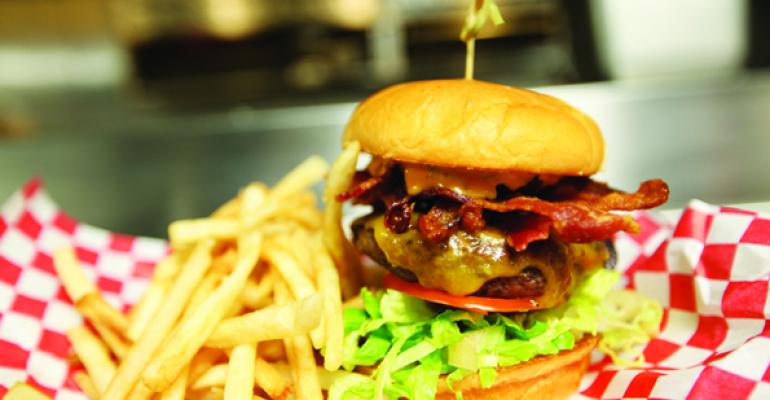
America’s love affair with beef shows no signs of slowing down. Even during these economically challenging times, restaurateurs are buying more of it, many steakhouses are seeing growth in customer traffic, and, according to a recent report from the Zagat Survey, three-quarters of Americans eat hamburgers for dinner. Two percent even said they eat them for breakfast.
Restaurants are striving to meet growing demand: 97 percent of operators had beef on their menus in 2011, and overall beef purchases for that year were up by 12.6 percent over 2010, according to 2011 volumetric data provided by the National Cattlemen’s Beef Association.
But with already high beef prices expected to rise throughout 2013, restaurateurs are also developing methods to keep their customers’ infatuation with beef from being derailed by sticker shock. They’re employing a variety of purchasing strategies, quality-control efforts and recipe adjustments to ensure they can offer consistent, flavorful beef dishes at attractive prices.
For many restaurants the process starts long before the meat even arrives at the restaurant.
DeWayne Dove, vice president of purchasing for SpenDifference, a purchasing cooperative of small and mid-sized chains, including McAlister’s Deli, Genghis Grill, Smashburger, Sizzler, Taco John’s, Pizza Ranch and others, said the high prices of corn resulting from the summertime drought led cattle producers to slaughter many more cattle than they would otherwise rather than pay for feed. As a result, fewer cattle are available for future demand. Since it takes about 18 months for a calf to reach the appropriate weight for slaughter, beef will be in short supply through 2013 and possibly into 2014, Dove said.
RELATED
• No commodity cost relief in sight for restaurants
• Beef prices expected to exceed record highs in 2013
• More restaurant industry commodities news
“It’s not like poultry, where we can turn it around in six weeks,” he added.
To help manage costs, Dove has employed a number of strategies, ranging from using slightly less lean beef in hamburgers — 78 percent instead of 80, for example — to using his cooperative’s purchasing power to create efficiencies for manufacturers, allowing them to grind meat to a particular specification for a longer period of time.
It’s not just a question of cost these days, however; it’s a question of getting the beef you want at all.
“Recently, we’ve noticed that not only do we have to protect our cost and break out all the tools to do that [including buying longer-term beef contracts and using advanced inventory control software], but we also have to protect our supply,” Dove said.
Gibsons Bar and Steakhouse, which operates three locations in the Chicago area, went so far as to get its own U.S. Department of Agriculture certification for its beef.
The certification, USDA Gibsons Prime Angus, specifies the feed the animals get, where they are raised, and the finished product’s flavor and marbling.
“Our purveyors suggested we do it,” owner Steve Lombardo said, adding that the grade has been in place for three years.
Gibsons corporate chef Randy Waidner said he worked with the farmers and breeders with whom he had already established good relationships to develop the specifications for USDA Gibsons Prime Angus.
“It’s almost an insurance policy to guarantee the supply that we get,” Waidner said. He added that his suppliers know what he needs and how much of it, and with such precise specifications, he gets very consistent, size, shape, marbling and texture.
The beef is used in everything from $50 steaks to $12 hamburgers.
“So much of our business is from local customers who come in three, four, five times a week,” Lombardo said, adding that they can only maintain that high frequency if some items are offered at a lower price point.
Besides, he said, “some of those lower-priced items give us a little more of a higher margin.”
Controlling waste
John Uzelac, vice president of operations for seven-unit Rib & Chop House and two-unit Rio Sabinas, headquartered in Billings, Mont., agreed that good relationships with suppliers and distributors are crucial to managing prices. But, he said, so is controlling waste, which is why restaurant managers are the only people allowed to cut steaks in his restaurant.
“We know that they’re in the best position possible to cut to our exact specifications,” he said.
Uzelac purchases primal cuts for all the restaurants’ steaks to help manage costs. He also makes sure his customers are aware of non-beef options.
“Our pork ribs are front and center on the menu,” he said.
Better-burger chain The Counter is looking into bison as beef prices rise. The 36-unit chain based in Culver City, Calif., is testing the beef alternative in select markets now and offering it as an option for franchisees.
Otherwise the chain uses a custom blend of 75 percent lean shoulder meat from an all-natural supplier. With added trimmings, the blend is 80 percent lean.
“We feel that if it’s any leaner, we have a drier flavor,” but higher fat levels cause flame-ups on the grill, The Counter chef Andrew Evans said.
Evans uses the beef in a range of customizable burgers and “bowls,” the latter being burger patties on a bed of greens.
The Counter allows customers to build their own burgers and bowls using a variety of toppings and sauces. The most popular version is the standard Counter Burger, a beef patty on a plain bun with lettuce, tomato, fried onion strings, sautéed mushrooms, provolone cheese and a sun-dried-tomato vinaigrette. A standard burger with cheese and up to four toppings costs between $9.50 and $11.
Others are experimenting with ways to cut out costly lean meat without adding fat.
Eric Ernest, executive chef of the University of Southern California in Los Angeles, recently started adding finely diced, cooked mushrooms to his hamburgers at two of his foodservice outlets: the fine-dining Moreton Fig and a sports bar called Traditions.
“We do what we call an umami mix,” Ernest said. The mix is a rib eye-chuck roll blend made up of about 20 percent mushrooms — mostly standard white button mushrooms with some cremini mushrooms added. That blend is Ernest’s standard hamburger mix for Moreton Fig and Traditions, but he occasionally spices up the mix with more robust mushrooms, such as shiitakes.
“We’re not looking for a lot of distinguishable mushroom flavor in the burger itself,” he said. “We’re looking for a neutral, earthy flavor.”
He grinds the mushrooms and cooks them down to about the appearance and shape of ground beef, then adds that to the raw beef and cooks them normally. The mushrooms provide moisture, umami, a lighter mouthfeel, and lower calorie and fat levels, while offering food-cost savings of between 10 percent and 20 percent.
Contact Bret Thorn at [email protected].
Follow him on Twitter: @foodwriterdiary