

With President Barack Obama’s re-election removing any doubts that the Patient Protection and Affordable Care Act will take effect in 2014, operators are hurriedly hammering out strategies to manage the anticipated cost increases tied to providing employee health care coverage.
Even as employers await regulatory details for several critical aspects of the law, they are grappling with such fundamental questions as what their workforce looks like and whether they are better off paying for coverage or eating penalties tied to noncompliance.
Under the law, companies with 50 or more full-time equivalent, or FTE, workers must provide health insurance options that meet minimum government standards for coverage and affordability. Companies not providing insurance will be fined $2,000 per FTE employee per year, and as much as $3,000 per FTE worker per year should the coverage offered not meet government requirements.
For restaurant operators, deciding how their companies will administer and pay for the new insurance is further complicated by such peculiarities of the industry as its high turnover, numerous part-time workers and a large population of tipped employees.
Because of these peculiarities, even leaders who have worked to understand the PPACA since it became law in 2010 admitted they still don’t fully comprehend its implications — and many pointed to an onerous number of unintended consequences, as well.
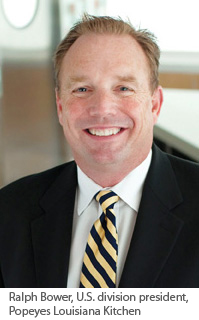 “It doesn’t matter how much you know about this; every time I meet with consultants for questions, I learn something I didn’t know before,” said Ralph Bower, president of the U.S. division of Popeyes Louisiana Kitchen.
The Atlanta-based chain with 2,100 units has invested thousands of man-hours and tens of thousands of dollars to research the PPACA and disseminate that information to franchisees.
“We’ve been at this for a little more than a year,” he said. “We’ve had eight meetings with our cross-functional team [of franchisees and corporate staff], plus our HR staff has put a lot of work into this, in addition to their regular jobs. But we’re still not clear on what our response will be.”
Polling time
What is becoming clear is the high cost associated with coverage, said Robyn Piper, a health and welfare consultant with Piper Jordan in San Diego. Her large restaurant-chain clients gradually are moving from being overwhelmed by the details in the 906-page law to better understanding the substantial costs and burdens of compliance.
“It’s been especially hard on HR and benefits departments — staffs that were not left unscathed by the recession,” Piper said. “There are a lot of days where you see foreheads on the table as they try to get their heads around these big numbers — and they are heart-palpitating numbers.”
Employers should now be evaluating the complexion of their workforce. Such efforts have led to some high-profile headlines about plans to cut employees hours, but the exercise should not be taken lightly.
With the help of benefits consultants, lawyers or accountants, employers should conduct government-mandated assessments, or “polling periods,” looking at stretches of time spanning 60, 90, 120 days or longer to determine the number of full-time and part-time workers on their payrolls.
As 2014 draws nearer, operators have less time to poll and make accurate calculations.
Knowing which positions require full- or part-time employees is critical to assessing a company’s obligation, Piper said.
“That assessment potentially narrows down who insurance benefits will be extended to,” Piper said. “It’s especially important for companies that might not have 50 FTEs when all those part-time hours are added up.”
While the industry’s notoriously high turnover rates could complicate polling, Piper said such evaluations would at least provide data that will help companies decide whether every position is needed.
The assessments also are shedding light on the potentially steep cost of insuring workers.
According to Bower, Popeyes’ monthly contribution will be in the neighborhood of $200 per eligible employee.
Craig Dunaway, president of Cincinnati-based Penn Station East Coast Subs, said the 252-unit chain will pay “about $2 per hour per [eligible] employee, which, spread across a year, is about $3,000 per employee out of pocket for us,” he said. “That’s a cost that makes us ask what positions we might be able to get rid of.”
Employee sticker shock
The high price tag could likely make employees balk, too, according to employers like Bower, who puts the cost to eligible Popeyes employees at $130 per month.
“Right now we offer a mini medical plan to all hourly employees, and their contribution is $10 a month,” he said, noting that Popeyes contributes $36.60 each month toward an hourly employee’s insurance.
“Even at that cost, only 5 percent of our hourly employees participate,” he said. “How can we expect they’ll want to pay $130 a month?”
Bower noted that the law also stipulates single-member-household employees whose annual income exceeds $14,865 must purchase some form of insurance or face a fine of $100 in 2014. Should employees decline insurance provided by an employer, they must purchase it from a state health insurance exchange. Currently, 17 states have said they won’t create insurance exchanges, which, according to the new law, puts the burden onto the federal government.
While the fine to the employee increases markedly with each year, Bower said, “it’s still considerably less than what they’d pay for the actual insurance. … And does the IRS really have the ability or the desire to collect those fines? And who would want to be so politically unpopular to enforce those collections?”
Belinda Sharp, vice president of human resources at 712-unit Ruby Tuesday, said insuring tipped employees will be particularly challenging in states where those employees’ hourly rates are well below minimum wage. Servers, in particular, often make so much in tips that what they must pay in taxes reduces their paychecks to nothing — or less.
“We’re still looking for guidance in the law in that area,” said Sharp, adding that the company has worked to prepare for compliance since the PPACA was passed. If the company is responsible for gathering tipped employees’ insurance contributions, she said “that puts us in the position of being bill collectors, which isn’t good for morale. So, since so many don’t get a check at all, do we extend credit to tipped employees to cover that [insurance premium]? It’s a whole can of worms we’ve got to open up.”
The Maryville, Tenn.-based chain also is investing significant resources into revamping I.T. systems to comply with new reporting requirements. Sharp said the company has to disclose to employees and the federal government what it’s paying in insurance premiums. In addition, she said she suspects states may have their own unique reporting demands.
“That’s a big burden that will result in increased administration costs,” Sharp said.
Weighing penalties
Steven Friedman, chair of the employee benefits practice at New York-based law firm Littler Mendelson, said some of his clients, which include restaurant companies and other businesses, are weighing the cost of not insuring their employees and instead paying the $2,000-per-employee penalty.
“Given the costs involved, it’s truly something to think about,” Friedman said. “It’s an issue for companies that want to be considered an employer of choice. They want to get the best employees, so they pay the cost of insurance.
“But others want to do just what the market requires, yet they don’t want to be perceived as less generous than other companies in the market. So they’re waiting to see what the other guy is doing before they decide.”
The notion of paying the penalty has crossed the mind of Penn Station’s Dunaway more than once, but the former certified public accountant said the loss of the business tax deduction dissuaded him from that choice. To manage the costs, he’s considering menu price increases and potential staff reductions.
“Will this raise prices and cause the marginally employed to have their hours cut? I think the answer is yes,” Dunaway said. “In an industry where you’re negotiating for percentages of pennies on single packets of ketchup, you don’t have the room in your margins to absorb more costs. And now you’re talking about adding on a couple grand per employee every year.”
At Popeyes, where 98 percent of the chain is franchised, growth hangs in the balance.
“I was talking to a franchisee who has two restaurants, and now he knows that if he opens a third, it would put him over 50 FTEs. So yes, it’s an obstacle to growth,” said Bower, whose company holds regular webinars and created workbooks to educate franchisees about the law.
“I don’t think not offering health care coverage is the most cost-effective way to handle this, either,” he added. “What I think the most effective way to go is for the government to give [business] owners incentives to offer insurance. But ... the law is what it is.”