
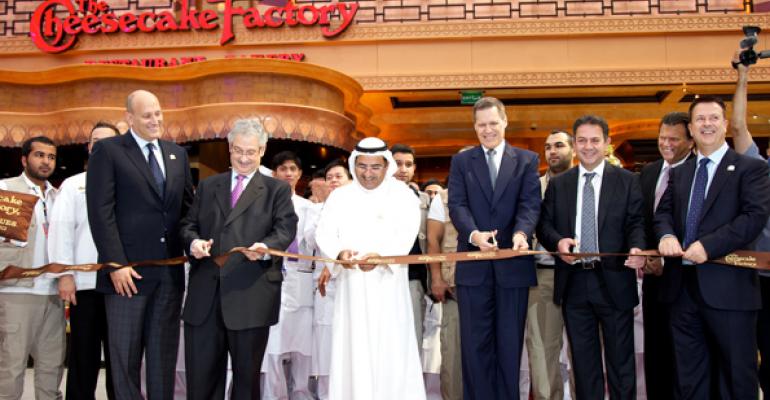
More U.S.-based restaurant companies are finding developers in the Middle East, making it one of the strongest regions for international growth of American brands.
Eager regional investors and a strong economy have trumped concerns about unrest in the region, leading a wide swath of U.S. restaurant brands to partner with Middle Eastern companies to open units and expand operations.
Slide show
American restaurants expand in the Middle East
RELATED
• Middle East seen as hot growth market
• Restaurants account for local tastes when expanding overseas
• More international restaurant news
The International Monetary Fund’s regional outlook for the Middle East, released in November, pegged economic growth at 5.1 percent in 2012, rising from 3.3 percent in 2011. The region’s oil-exporting countries of Algeria, Bahrain, Iran, Iraq, Kuwait, Libya, Oman, Qatar, Saudi Arabia, the United Arab Emirates and Yemen were expanding at 6.6 percent, “owing to higher oil prices and production,” the IMF reported.
Dallas-based Which Wich plans to open in Qatar, and Mount Olive, N.C.-based Highway 55 Burgers, Shakes & Fries has signed with an Abu Dhabi company to open 15 restaurants starting this year, and has an option for another 70 units.
Highway 55, a ’50s-themed diner, expects to open its first international location in Abu Dhabi in June. Guy Guthrie, Highway 55’s vice president of franchise sales, said Abu Dhabi-based Allied Brothers Co. is the brand’s first international master franchisee, and the company has committed to developing 85 units in the Middle East and North Africa region.
“Any challenges in building our brand overseas will quickly become opportunities with their help and deep knowledge of the region,” Guthrie said in an email.
Beautiful Brands International — which owns the Camille's Sidewalk Café, FreshBerry Frozen Yogurt Café, Rex's Bite Size Chicken and CherryBerry Self-Serve Yogurt Bar brands — expects to surpass 100 units in the Middle East this year, said David Rutkauskas, founder and chief executive of the Tulsa, Okla.-based company.
“I believe the potential is huge for franchises in the Middle East,” he said. “There's a great market for American goods and services, plus governments are encouraging foreign investment into local companies and offering competitive tax and financial incentives to attract outside interests.”
“American brands rule,” said Chris Tripoli, president of A’La Carte Foodservice Consulting Group in Houston, who has worked with concepts in Kuwait; Saudi Arabia; and Muscat, Oman.
The popularity of U.S. brands in general extends to restaurants in particular, Tripoli said. “Many Middle Eastern families tell me eating out is their preferred form of entertainment,” he said. In Saudi Arabia, for example, “there are no cinemas, so dining and shopping are the evening thing to do,” he said. “Malls open late and grocery stores are busiest after dinner. Dining out three times a week isn’t out of the norm.”
Still, the region poses challenges for U.S. brands. “Product procurement can become an issue and not all types of American dining segments are popular,” Tripoli said. “The fast-casual style of service is not well accepted yet, and Mexican food isn’t very popular.”
Recent expansion agreements
Vancouver, Wash.-based Papa Murphy’s Take ‘N’ Bake Pizza said in the fall that it planned to open in the region, following other players like Tea Lounge, Smashburger, Mooyah, Fatburger, Nestle Toll House Café and Naked Pizza.
Steak 'n Shake signed a deal to expand the full-service burger brand to the Middle East. The concept, owned by Biglari Holdings Inc. of San Antonio, Texas, said in October it had inked its first international development agreement with the Saleh Bin Lahej Group to open 40 restaurants throughout the United Arab Emirates.
The Saleh Bin Lahej Group already franchises U.S.-based brands such as Chili's Grill & Bar, Romano’s Macaroni Grill, Black Canyon Asian Cuisine, El Chico, The Pizza Company and Cantina Laredo.
“The UAE will be the springboard from which we plan to grow the Steak ‘n Shake brand in multiple dimensions and in many other countries, ” Sardar Biglari, chairman of Biglari Holdings, said in a statement at the time. Steak 'n Shake has about 500 restaurants in the United States.
Atlanta-based Focus Brands Inc. has a growing presence in the Middle East, with more than 100 units of its Cinnabon chain in Saudi Arabia, and 1,000 internationally of its full brand portfolio, which includes Auntie Anne’s Pretzels, Carvel Ice Cream, Seattle’s Best Coffee, Moe’s Southwest Grill and Schlotzsky’s.
In November, The Cheesecake Factory debuted in Kuwait, after launching in Dubai in August. The Kuwait unit in The Avenues mall seats 475 guests and measures 13,160 square feet.
“The Cheesecake Factory’s arrival in the Gulf has been overwhelmingly positive, reflecting our great potential in the region and affirming our decision to expand into the Middle East as part of our global expansion,” David Overton, chairman and chief executive of Calabasas Hills, Calif.-based The Cheesecake Factory Inc., said at the time.
The casual-dining chain is being developed in the Middle East by the Kuwait-based M.H. Alshaya Co., which is developing other brands, including Texas Roadhouse, P.F. Chang’s, Pinkberry, Potbelly Sandwich Shop, Shake Shack and Starbucks.
Alshaya’s exclusive licensing agreement with The Cheesecake Factory provides for the development of its restaurants across the United Arab Emirates, Kuwait, Bahrain, Qatar and Saudi Arabia. The agreement also gives Alshaya the opportunity to expand The Cheesecake Factory into its other operating markets in the Middle East and North Africa, Russia, Turkey and Europe.
Contact Ron Ruggless at [email protected].
Follow him on Twitter: @RonRuggless