
Prince Alwaleed Bin Talal Alsaud, whose Saudi Arabia-based Kingdom Holding Company has sizable investments in Apple, Citigroup, Four Seasons Hotels and even Twitter, is ranked No. 29 on Forbes magazine’s 2012 list of billionaires and No. 1 in Saudi Arabia.
Although his vast wealth means he can dine wherever he’d like, speaking from behind his desk in the regally appointed 66th-floor office of his sleekKingdom Centre skyscraper in Riyadh, he admitted his family has a fondness for fast food, especially the homegrown Herfy chain.
VIDEO

Watch Diverse Workforce in Saudi Arabia
RELATED
• Smashburger opens in Costa Rica
• Moe’s Southwest Grill expands into Russia
• More international restaurant news
“I still order from Herfy,” said the prince, who in the mid-1990s served as de facto chairman of Herfy Food Services Company through an investment in the Panda supermarket chain. “Every two weeks at my home we have ‘fast-food day,’ and we order fast food from Herfy. We order everything from them: the chicken, the hamburgers, everything. It all comes from Herfy. No other brands are permitted.”
The prince, who is vegetarian, doesn’t partake.
“On that day, they make for me a special vegetable burger and a burger without the bread.”
But on the prince’s fast-food day, it’s about the family.
“On that day, my son and daughter and granddaughterscome,” Alwaleed said. “This has been happening many years. It’s ‘Herfy day.’”
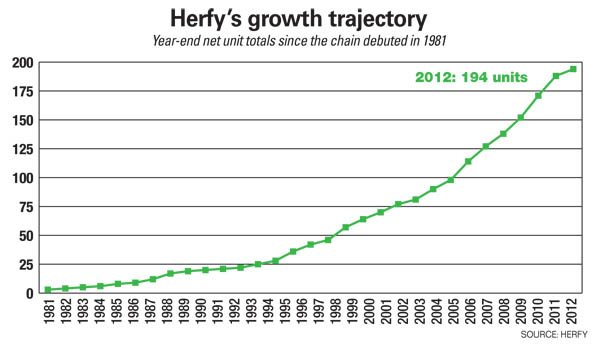
Such loyalty to the Herfy brand extends well outside the kingdom’s royal family and is one of the many challenges awaiting U.S. brands as they look to grow in the Middle East. Others include cultural and dietary customs that demand men and women dine separately, and the practice of eating only halal meat.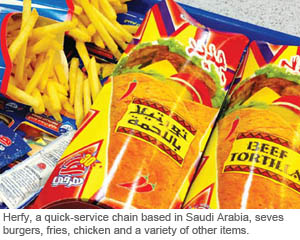 Since its founding in 1981 by Ahmed Hamad Al Saeed, who remains the company’s chief executive, the now-194-unit Riyadh-based Herfy chain has woven itself into the fabric of the Gulf kingdom as well as several other Middle Eastern countries with its signature Super Herfy hamburger, its Super Chili Chicken and its even more popular spicy Chicken Tortilla wraps.
“Herfy has one of the best earnings growth visibilities — 11 percent compound annual growth rate — free-cash-flow generation capabilities and balance sheets” of Saudi Arabian food companies, wrote analyst Nada Amin of EFG-Hermes, an investment bank based in Cairo, in September. “Store yields have been rising at well over 5 percent since [first quarter 2011] despite no price increases, which indicates higher footfall as the store maturity cycle improves.”
Saeed’s Herfy rivals such fastfood burger players as Jollibee in the Philippines and Quick in Belgium for its regional power. According to data from Euromonitor International, Herfy is the fourth largest chain in the Middle East-Africa region in terms of systemwide sales and number of units. Its parent company, Savola Group, is the fifth largest in terms of systemwide sales.
'A competitive edge'
“As the best-known brand in QSRs in Saudi Arabia and the first Saudi Arabian QSR brandto the marketplace,” Saeed said, “we believe we are able to bring new products to the market faster, to select premium real estate and to have a price and value advantage the others don’t have.”
Saeed noted that Herfy has been able to hold the line on restaurant prices since 2010 despite commodities headwinds. Herfy’s combination meals range from 15 to 18 Saudi riyals, or $4 to $4.80.
“We have the competitive edge,” Saeed said, “because we own our own bakery, meat processing plant, commissary and distribution facility. All of these contribute to our lower costs and premium-quality products. In addition, this ensures we have a smooth, safe and secure supply chain.”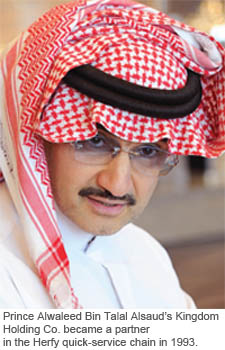 That has given Herfy wide berth in pricing power, analysts said.
“We believe Herfy could easily raise its menu prices, especially given that it has not increased prices in the past two years,” EFGHermes analysts said.
Much of that pricing power is a credit to “the vertical integration of their supply chain,” said Oliver Brown, a restaurant consultant based in Live Oak, Fla., who is familiar with Herfy. Brown, a veteran of the Burger King system, was brought in with another U.S. advisor by Alwaleed in 1993 to work with the Herfy organization.
“The prince’s concern was whether Herfy could compete successfully with Burger King and McDonald’s, which had just entered the kingdom,” Brown recalled. “The reason they hired me was their menu was a close knockoff of Burger King, except they had bone-in chicken.”
Brown said his analysis found Herfy was strong.
“We looked at their cost structure, we looked at their real estate, we looked at their management structure, and we decided that with some minor changes, Herfy could be very successful,” Brown said. “There was also a halo effect of being Saudi-owned.”
Brown said one problem was trade dress, which was varied among the units because of the long supply chain, with most of the furniture and equipment sourced from the United States.
“It really was mix and match, but we got that straightened out,” he said.
In addition, the Saudi market had special issues, such as the requirements of the Muslim faith for halal meat and the division of genders within the restaurants.
“You have to have a separate dining area for the women and children to separate them from the males,” he said. Herfy and other public eateries, including the wide variety of U.S. brands already open in Saudi Arabia, must provide designated areas for women and families, including booths with curtains that can be pulled closed so the women can remove the veil of the traditional black abaya covering to dine.
Such hurdles have not kept U.S. chains from scouting out Saudi Arabia, which boasts a large population of expatriates and a culture of shopping and eating out.
Still, Herfy has a number of advantages over franchised U.S. brands, including a lower cost of doing business, Brown said.
“Their competitors have to pay 4 or 5 percent royalty on the top just for the use of the brand, but Herfy has built its own brand and doesn’t have that cost disadvantage,” he said.
Herfy also is adept at winning prime real estate locations. The company owns about 20 percent of its locations in the kingdom and leases the remainder. Units can range from 2,500 square feet to as much as 4,800 square feet.
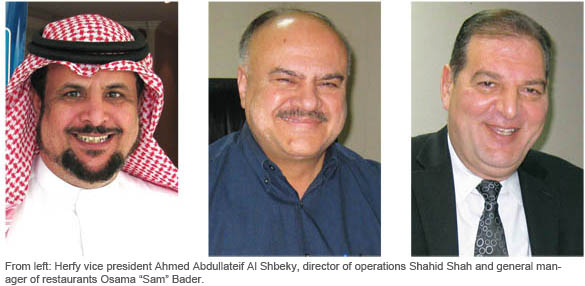
Ahmed Abdullateif Al Shbeky, Herfy’s vice president, said the company “is always looking for distinctive restaurant sites. … We will negotiate directly with the site owners to obtain the best costs, whether we are buying or leasing the site. The reputation and long history of Herfy has allowed us to select the best locations in Saudi Arabia and to negotiate excellent competitive pricing for these sites.”
A look inside
Stable management has helped, too, Brown said. “The No. 1 thing about Herfy is the continuity of competent management, from the operations people to the CEO,” he said. “A lot of the people I worked with 20 years ago are still there, including Mr. Saeed.”
Osama “Sam” Bader, Herfy’s general manager of restaurants, said the longevity has led to consistency for the brand.
“The more experienced the people that you have, there are results that you can get,” Bader said. “They understand the business very well. They contribute to the growth in sales.”
The company also seeks out new executives and fresh management, Bader added.
“You need those fresh ideas,” he said.
Founder Saeed added, “We are very proud to have over 80 percent of our managers who have been promoted internally due to the development opportunities and training we provide.”
Herfy provides on-the-job and classroom training for managers before they are placed in their positions.
“These courses involve operations, administrative classes, behavioral management and equipment maintenance,” Saeed said. Training is provided in both Arabic and English.
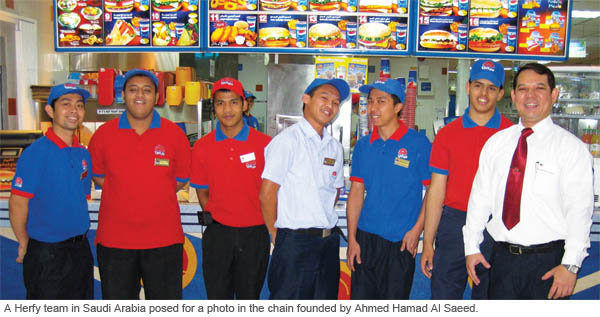
Like most retail businesses in Gulf-region nations, Herfy relies on imported labor from such countries as Nepal, Pakistan and the Philippines. But over the past two years the kingdom has been putting increased emphasis on its “Saudization” program, which aims to have 30 percent of employees in the kingdom’s businesses be Saudi nationals.
The king has emphasized this policy to encourage employment of Saudi nationals in the private sector — which is dominated by workers from Southeast Asia and Western expatriates — through monetary incentives.
Alwaleed said Saudization "is very important for us for national security. Saudis are beginning to accept the idea of being chefs, waiters and back-office [workers], etc.” Herfy is now at the high end of the designated target, he said.
“From the macro point of view, you are going to have [fewer] expatriates here and less pressure on hospitals, schools, universities, roads, water,” he said.
In a desert kingdom, water is a particularly scarce resource, especially on the plateau in the middle of Saudi Arabia where Riyadh is located. Water is piped from desalination plants on the coast.
“We are joining the industry in our concern about all phases of recycling,” Saeed said. “We live in a country with water challenges, and we support tight water-management controls. We were first to the market with cooking oil, cardboard and paper recycling and remanufacturing. It is sold to a recycling company, and this is helping usreduce our carbon footprint.”
Variety, spice of business
Shahid Shah, Herfy’s director of operations, noted, “Chicken items are very popular with our customers’ tastes. The locals like chicken, especially the Chicken Tortilla and the Super Chili Chicken. But the beef, with the Super Herfy burger, is also popular.”
The Chicken Tortilla is wrapped in a red-chile-flecked product imported from Canada.
“We have that exclusively,” Shah said. “You can’t find it in the local market, so it’s special to Herfy.”
The item features a curryflavored sauce, lettuce, tomato and a sliced chicken breast fried with a spicy breading. The tortilla wraps also are offered with beef and fish, the latter of which comes with a tartar sauce.
“We started in the hamburger segment,” said Shah, who has been with Herfy for 28 years. “Then we added bone-in chicken, and chicken is now the top. In terms of variety, nobody is doing it the way Herfy does.”
The company introduces at least two new items each year to “keep the customers coming in,” he said.
Saeed said Herfy’s diverse workforce also provides fertile ground for products.
“Our people are always exploring and researching new products,” he said. “Our employees — who we hire from all over the world — give us great ideas. Also, reading about and watching our competitors helps us.”
Saeed said the integrated company has the advantage of flexibility, as well.
“Having our own bakeries, commissary and meat processing facility means we make over 95 percent of our own products,” he said. That makes the research and development process shorter and faster.
“We can more tightly control our quality and create new products much faster than any competitors,” Saeed said. “We also know that being Saudi-owned and -operated, plus being one of the oldest [fast-food chains] and a pioneer in the market, gives us a distinct advantage with our customer base.”
“Herfy’s typical customer is taste driven,” said Sherko Felo, Herfy’s director of marketing, advertising and franchise. About 85 percent of the customers are Saudi nationals, and 15 percent are expatriates or of other Arab nationalities, he said. The company also boasts a significant carryout business, with 104 of its units having drive-thru lanes. Because women in Saudi Arabia are not allowed to drive, many orders are called in, and drivers employed by families pick up the meals.
American influences
Herfy is no stranger to innovation. When Saeed first developed the concept to open next to a Panda supermarket in 1981, he relied on his experiences from studying in the United States toguide his creation.
“Like other Saudi children,” he recalled, “I had my mother’s cooking, God bless her soul. There were no restaurants or hamburger restaurants.”
He first encountered the hamburger in 1972, when he was studying in Los Angeles for his master’s degree.
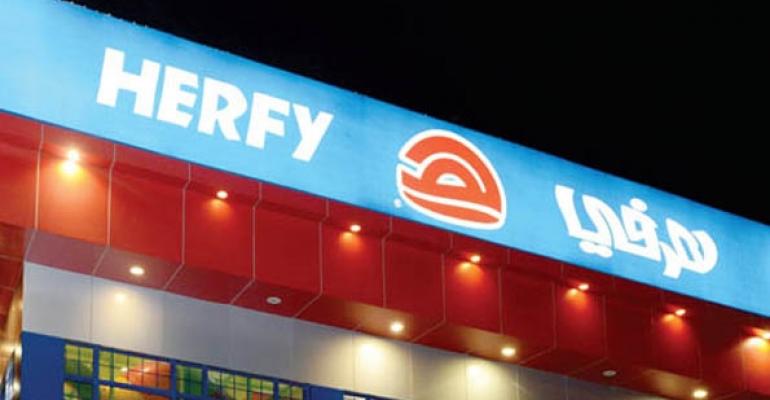
Saeed landed on the name Herfy, which in the regional Arabic dialect is the word for “the small local sheep.” For more than the first decade of Herfy’s existence, the logo featured a black-and-whiten lamb.
“At the time,” he said, “it was a joint project with the owners of the Panda supermarket, which had started in the late 1970s. I joined them with the wish to start a restaurant.”
They settled on the name Herfy for its connection to food — “a young and tender meat,” Saeed said.
“I went to the market where they sell sheep and lambs, and I bought one that was exactly as I wanted,” he said. “It was black and white. I took it to an advertising company because they didn’t know what the herfy was.”
The marketing pros took a photograph of the lamb’s head, and it became the early logo for Herfy.
That did create some bene cial confusion, Saeed admitted, as some customers at the adjoining Panda supermarket thought Herfy was a butcherbusiness, not a foodservice one.
“Our first customers thought we were serving herfy meat, but we were importing the beef from the United States at the time. It was an advantage for us.”
Saeed emphasized that the Herfy concept in Saudi Arabia has no connection to the Herfy’s chain in the Pacicfic Northwest.
When Alwaleed’s company became a partner in 1993, the executives decided to revise the logo to avoid confusion.
“We came up with something between a lamb and a cow,” Saeed said, but the logo evolved eight years ago into a stylized form of the Arabic character
for “h.”
“And it resembles a hamburger,” Saeed said with satisfaction. The logo has become a distinctive feature in the design of Herfy’s red-and-white signage and trade dress.
Moving forward
Herfy plans to open several more restaurants by the end of the year, Bader said.
Abdulraouf M. Mannaa, managing director of Savola Group, which holds a minority investment in Herfy, said, “I think Herfy has a lot of room to grow. We’re very strong in the central region [of Saudi Arabia], and we can grow more in the other regions. We need to focus on the other cities. There is huge room for us to grow, even perhaps into other formats such as family dining.”
Saeed said, “I would like to see us grow our brand beyond the Middle East market, and we are actively exploring this arena for the next five years.” Herfy currently has seven licensed units in Kuwait, four in the United Arab Emirates and one in Bahrain.
Saeed’s son, Khaled Ahmed Hamad Al-Said, who serves as Herfy’s investment director, said the company sees opportunities in franchising outside of Saudi Arabia.
“We believe that great opportunities lie in the franchising and expansion of our trademark and brands all over the world,” he said, adding that the company sees opportunities to expand its real estate investment portfolio.
The company also sees opportunities to use technology to improve operations. For example, given the long lines at drive-thrus, Herfy is considering handheld tablet technology to reduce driver wait times.
The company plans to keep its cost controls as it expands.
“Planning is the key to our success, and we use all of our departments to support that growth,” Saeed said. “We always forecast our costs and have the ability to control our quality and costs by having our own manufacturing facilities. Buying on the futures helps us keep a competitive edge along with our strong balance sheet. Lastly, our training of all our staff means we control costs at the unit level.”
Consultant Brown said Herfy has been careful with its expansion plans.
“There is always pressure to open up new locations,” Brown said, “but Herfy has been disciplined in opening up restaurants when the population shift hasmatched the demand.
“Herfy’s success has been based on a combination of cost structure and experience and competent management and a vertically integrated supply line,” Brown continued. “They have a verystrong consumer franchise.
Contact Ron Ruggless at [email protected].
Follow him on Twitter: @RonRuggless