

Even as the economy puffs along on its rocky road to recovery, consumers just aren’t frequenting restaurants for deals like they once did. It’s not that diners aren’t looking for a bargain. It’s that some of the most frequently used deals — combo meals and value menus — apparently are not as appealing as they once were.
However, one deal type that continues to be attractive to tight-fisted consumers is coupons.
According to market research firm The NPD Group, overall deal traffic has declined over the last two years. In the year ended August 2012 deal traffic slipped 1 percent on top of a 2-percent decrease in the preceding year.
RELATED
• Holiday party outlook good for restaurants
• Survey: Consumers name Panera favorite sandwich chain
• More consumer trends
Value-menu items and combo meals, which rank among the deals offered most often, largely are responsible for the deal traffic falloff . Combo meals have been on the decline for a number of years, while the value-menu declines began more recently.
Combo meals and value menus have become so commonplace that consumers often don’t perceive them as being a deal anymore, NPD analyst Bonnie Riggs said. At the same time, operators are discounting other items, but they are often things consumers don’t want, even at a lower price.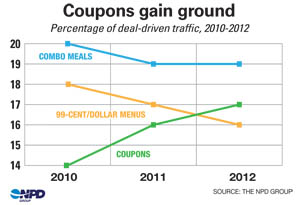 Meanwhile, coupons have continued to grow in popularity, largely driven by Internet coupons, which accounted for 3.4 percent of all deals used this past year. The use of mailed coupons also has increased, now accounting for 5.3 percent of all deals.
Customers easily can easily find restaurant coupons all over the Internet these days, from social media and review sites to coupon clearinghouse sites. But according to NPD, the most popular Internet source for information on a restaurant, and a restaurant’s top platform for coupon distribution, is its own website.
“The No. 1 place consumers go to find out about restaurants, to get deals, is the restaurant’s website or the text message they receive from the restaurant,” Riggs said. “That is where consumers go first. It’s not Facebook, not Twitter.”
Baby boomers largely are responsible for the growth in overall coupon usage and Internet coupons, in particular. However, Internet-coupon usage also is growing with adults over 65 and those aged 25 to 34. Adults 50 to 64 account for nearly one-third of all coupon usage. In the year ended August 2012 this group increased its overall coupon usage by 13 percent and Internetcoupon usage by 17 percent over the prior year.
Adults over 65 accounted for the second-largest level of coupon usage, at 21 percent. During the same period, these seniors increased their coupon usage by 11 percent and Internet-coupon usage by 15 percent. Adults 25 to 34 accounted for 17 percent of all coupon usage, and increased their overall coupon usage by 4 percent and Internet-coupon usage by 24 percent during that period. Typically tech-savvy young people aged 18 to 24 accounted for just 8 percent of coupon usage. Their overall coupon usage declined by 8 percent, and their Internet-coupon usage declined by 5 percent.
The importance of coupons likely will continue to grow in the coming year given that NPD recently revised its 2013 industry forecast downward to zeropercent traffic growth for 2013.
“The reason why it’s so important to get consumers to think they’re getting a deal is because of the negative forecast,” Riggs said. “Operators need to find ways to drive traffic.”
Couponing can drive traffic
Many operators already are finding that strategic couponing can drive traffic and increase trial without impacting margins or devaluing the brand.
Lenny’s Sub Shop, a 150-unit chain based in Memphis, Tenn., has been focused on direct-mail coupons sent to local businesses for the last year. The deals range from buy-one-get-one-free subs to free chips and a drink with the purchase of a regular sub.
So far the business-to-business coupons have performed extremely well for Lenny’s, officials said, earning a response rate above 50 percent.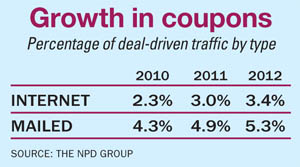 Lenny’s also has found success with promotions like Social Wednesday, for which it sends Facebook friends a coupon each Wednesday. Lenny’s president Brent Alvord linked consumers’ increased use of coupons to the freshness of the deals and a desire to use them before they expire.
“Combos and value meals are expected,” he said. “A coupon raises the need to take action, versus a value menu or a combo meal, which will be there the next time [customers] go. If [consumers] have something in their hands, they feel obligated to use it. That phenomenon is responsible for the trend.”
While the Philly Pretzel Factory offers lunchtime combo meals, it has focused heavily on coupons because officials said its consumers perceive them as a better deal.
“[Combos are] not traditionally deals in terms of savings; they’re bundles,” said Marty Ferrill, president of Philadelphia-based Philly Pretzel. “People don’t see it as that great of a deal. Truthfully, it’s not. … [They] may only save 25 cents.”
Currently, the 120-unit pretzel chain is having success with its newest coupon program, Funday Monday. Every Monday the chain posts a different coupon on Facebook and Twitter that its friends and followers can redeem on that day only.
Philly Pretzel’s online coupons offer customers a significant savings compared to its combo meals. For example, a recent Funday coupon offered buy-three-get-three pretzels. Traditionally, three pretzels cost $2.
“The offers are much more aggressive, so we see a much higher return. We can still make margins on them,” Ferrill said.
Coeur d’Alene, Idaho-based Pita Pit also has reaped the benefits of couponing, but the chain said the key to its success is tiedto the timing of the offers. For example, the 191-unit chain e-mails coupons to its loyalty-club members just once a month and sends direct-mail coupons to local businesses just once a quarter.
In the 2 1/2 years since Pita Pit has been offering direct-mail coupons, it has seen redemption rates as high as 67 percent. Among the deals that have performed best are buy-one-getone pitas and $2 off a pita.
“Consumers are still very, very interested in value. … They get and understand $2 off,” said Tracy Carbonneau, director of marketing. "I think couponing, discounting, value is going to be a dominant thing in the industry.”
Nation’s Restaurant News has an exclusive agreement to obtain the NPD Group data and research findings that appear on the Consumer Trends page.