
Restaurant executives attest there really is no secret to the latest wave of sauce- and glaze-focused menu introductions and limited-time offers, saying it satisfies customers’ need for flavor exploration while giving culinary teams a cost-effective way to innovate.
RELATED
• Wing chains reveal post-peak strategies
• Restaurants can find opportunities with ethnic cuisine
• More restaurant industry food and beverage news
In new products from Chili’s Grill & Bar, Popeyes Louisiana Kitchen and Wienerschnitzel, much of the items’ flavor profiles come from new sauces for dipping or glazing, which chain officials said allows them to experiment, generate news and elevate their brands’ overall taste profile. Wing Zone has applied that mindset to its entire menu with the Flavor Fuze program, which lets guests take any of the chain’s 17 wing sauces and use them in salads, burgers, shrimp or fries.
Kicking it up a notch
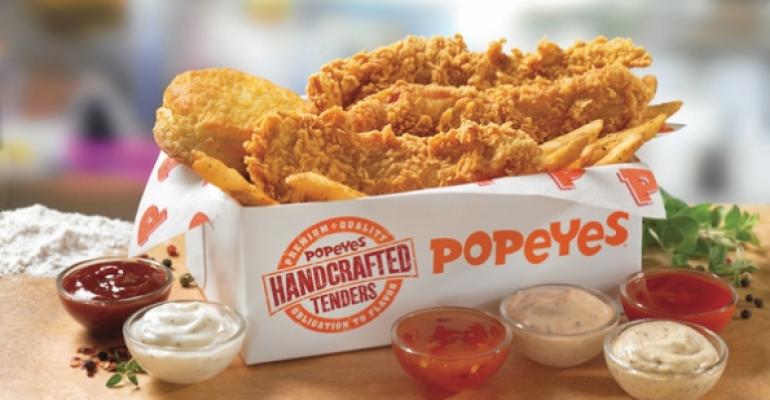
Dick Lynch, Popeyes’ chief global brand officer, said the chain focuses on being just as prolific in its development of dipping sauces as in its boneless-chicken lineup, including Wicked Chicken and Rip’n Chick’n, or the new Handcrafted Tenders, which rolled out Monday.

“It’s a little like a wine pairing,” Lynch said. “Each boneless product has a specific profile. Handcrafted Tenders are a little more of a blank slate, so that’s why we developed a whole line of sauces to enhance them.”
Handcrafted Tenders are the 2,049-unit brand’s relaunched chicken tender product and will anchor the boneless lineup permanently, he added.
As with all menu items, he said, the sauces play to Popeyes’ Louisiana heritage of Cajun and Creole food. In addition to barbecue and buttermilk ranch, the lineup includes Bayou Buffalo, with celery and Cajun seasonings; Sweet Heat, with honey and hot sauce; Mardi Gras Mustard, sweetened with Creole seasoning; and Blackened Ranch, which infuses the standard ranch with onion, garlic, peppers and the chain’s Blackened seasoning.
“Frankly, it’s fun for the chefs, it’s news for the category, and there is just a lot of room for innovation and creativity, especially when pairing it with a protein that has its own flavor profile,” Lynch said. “You could safely say it adds a lot of value to the product to have a unique sauce, for relatively little cost to us.”
 Hot dog specialist Wienerschnitzel also introduced a new product Monday, Der Chicken Dippers, a popcorn chicken item available with three sauces: Sweet and Tangy BBQ, Spicy Buffalo Wing, and Creamy Ranch.
The Dippers are sold in portions that start at $3.59 for one-third of a pound, up to one pound.
“We’ve always strived to give our customers variety paired with unique everyday value, and adding Der Chicken Dippers with tasty dipping sauces gives loyal fans yet another fun-to-eat menu option,” Tom Amberger, the 350-unit chain’s vice president of marketing, said in a statement. “Der Chicken Dippers did extremely well in our test markets, so we’re excited to make this menu item available to all of our guests.”
Intensifying a brand identity
Before Chili’s rolled out its new Pick-a-Pepper limited-time menu to its more than 1,500 locations on Monday, its corporate chefs were trying to accentuate the versatility of different kinds of chile pepper, from the smokiness of chipotle to the heat of red pepper.
Senior director of culinary innovation and executive chef Darryl Mickler said the casual-dining brand explored several applications for chile peppers. “But the best representation of what you can really do with chiles and can control is in a sauce base,” he said. “You don’t want to necessarily have all of the flavor in the proteins, because you want to keep things flexible when guests want to make alterations or maybe pull back on some heat in a dish. This easily lets guests control that, so they can go all in on some flavor if they want.”

He added that the menu applies new flavors to standard proteins for which Chili’s is known: Smoky Chipotle Chicken Fajitas; Santa Cruz Steak, served over fire-roasted corn salsa with tangy verde sauce and jalapeño-Cheddar mashed potatoes; Roasted Red Pepper Grilled Chicken; Chipotle Salmon; Spicy Grilled Shrimp Tacos, with a spicy chile-lime sauce; and Lighter Choices Sweet & Spicy Chicken, with a habanero-and-sweet-orange glaze.
Starting with familiar proteins let Chili’s get adventurous with its sauces while still keeping the products affordable, Mickler said, noting that the steak, chicken fajitas and grilled chicken products also are options for the $20 Dinner for Two.
“Value is a big piece,” he said. “We could bring in Wagyu beef or other proteins with less of a value component, but that might be too much risk for guests looking to try something new. We invest in flavors, but we don’t require guests to invest a lot more money than they’re able to.”
 Wing Zone, meanwhile, has spent much of the past year trying to get its guests more invested in its flavors, wrapping up a promotion earlier in 2012 in which fans got to rename all 17 of the nearly 100-unit chain’s sauces.
Starting in August 2011, the brand also began promoting its Flavor Fuze, which lets guests put any wing sauce on non-wing items. The longstanding practice had not been advertised until that point. The program “continues to gain ground,” and the number of Flavor Fuze orders has increased 50 percent over a year earlier, said cofounder and chief executive Matt Friedman.
“Guests are ordering more of our products flavored,” he said. “Wings are kind of a given, but we’re talking salads, burgers, shrimp and chicken tenders. My goal is that Flavor Fuze becomes part of our brand recognition.”
He conceded that Flavor Fuze has not driven a spike in orders of just non-wing items, but he noted that same-store sales are running 7 percent ahead of the year earlier through 2012, indicating that the practice has elevated perceptions of flavors throughout the whole menu. Sales of fries have stood out as the exceptional improver since the promotion of Flavor Fuze, he said.
In October, the chain will introduce a contest on Facebook where fans can suggest the next wing sauce flavor and vote for the winner in a “Flavor Playoffs” bracket through November.
“For a growing system like ours, we have to look at what’s easy to implement, so new flavors are our main focus going forward,” Friedman said. “Our whole calendar and marketing strategy are about seasonal flavors and limited-time offerings.”
Contact Mark Brandau at [email protected].
Follow him on Twitter: @Mark_from_NRN