
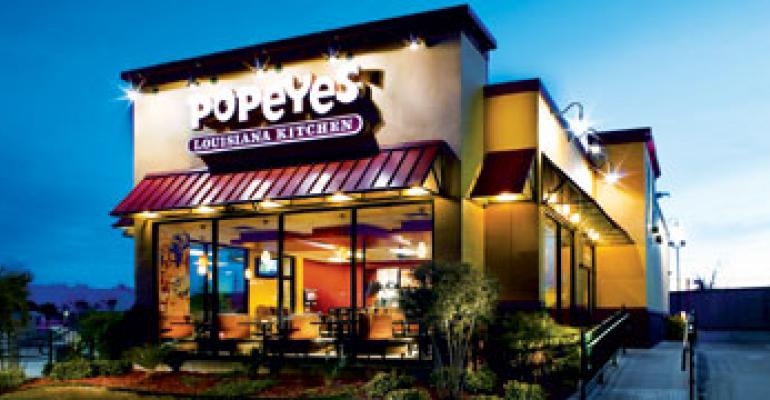
Popeyes: Promotions, efficiencies to offset commodities costs

Commodity prices will likely affect the bottom line for Popeyes Louisiana Kitchen franchisees in the coming year, but advance purchases of commodities, higher top-line sales and improvements in in-store efficiencies would “more than offset” the potential losses, president Ralph Bower told Nation’s Restaurant News after Popeyes’ parent company, AFC Enterprises Inc., released second-quarter earnings.

Bower said that rising commodity prices, particularly for corn, which is the main component of chicken feed, are expected to result in a 3-percent increase in food cost for the rest of the year, which would normally result in a 1-percent decrease in the bottom line.

He noted that Popeyes’ supply cooperative had locked in corn and meal purchases through September and was locking in other prices “on an opportunistic basis” for the remainder of the year. However, he said, the company was focused on driving top-line sales, “which is the surest way to drive bottom-line margins.”

For the quarter ended July 8, AFC reported net income of $6.6 million, or 27 cents per share, a 23-percent increase compared with $5.5 million, or 22 cents per share, a year earlier. The company's total revenue was $39.6 million for the quarter, a 12.2-percent increase from the $35.3 million a year earlier.

Same-store sales grew by 7.5 percent, marking the ninth consecutive quarter that the company saw an increase. During a conference call discussing the quarterly results, AFC chief executive Cheryl Bachelder attributed about half of that increase to the overall performance of the quick-service sector and the other half to efforts within Popeyes.

“The balance arose from our effective media, the broadening appeal of our brand, and menu innovation at compelling price points,” she told investors.

That media included the chain’s first nationwide social media campaign, the Mood Wing app, which assessed users’ social media activity and determined whether their mood was mild or spicy. The promotion, launched in May, was intended to underscore the two styles of Popeyes’ core product, bone-in chicken.

Next page

Continued from page 1

In June, Popeye's launched its boneless breast-based Rip’n Chick’n nationally after offering it regionally last year, and in July it introduced Zatarain’s Butterfly Shrimp, teaming up with another Louisiana company to reinforce Popeyes’ heritage from that state. The company also ran a Summer of Peach promotion featuring peach iced tea and peach pie that Bachelder said helped the chain achieve some of the best average weekly sales ever in June and July.

A continuing stream of menu promotions and growing efficiencies within its four walls put Popeyes in good stead for the rest of the year, Bachelder said, adding that the company had raised its guidance for same store-sales increases to between 5 percent and 6 percent, an increase of 4 percent to 5 percent from previous guidance, and she increased expected annual earnings per share from $1.13-$1.16 to $1.17-$1.19.

Cloud-based tech drives efficiency

Bachelder told investors she was “noticeably cautious on externals” such as commodity prices and the overall economy, and “noticeably optimistic on our brand.”

Bower later elaborated for Nation’s Restaurant News, “At the end of the day, commodities are an irritant, for sure, but you have to focus on the things you can control,” such as sales and in-restaurant cost controls, he said.

The company started collecting quarterly profit-and-loss statements from franchisees four years ago and put them in a standardized format so operators could compare their performance with others. “That has done a lot to improve profitability,” Bower noted, because it lets operators know where they might have inefficiencies.

He added that the chain’s cloud-based software that is now in nearly 300 locations helped operators keep track of their inventory and manage it better, resulting in a 1-percent savings in food cost. The company plans to use the software in 400 locations by the end of the fiscal year and to add it in another 400 locations annually until it is in all domestic units.

Bower said he was also working on using the software to manage labor, trying to ensure that enough staff is working during peak times, but not too many during slow times. “Historically, that’s been a very manual process," he said. "We’re still in the beginning stages, but I think we’ll have something in place by next year.”

He said that the cloud-based solution has brought down the cost of implementing the software tremendously — to around $150 a month, without the initial upfront cost of a $25,000 point-of-sale system.

“If we can get those tools to our franchisees, I think it could more than offset commodities,” he said.

Atlanta-based AFC Enterprises currently operates 40 Popeyes locations and franchises 1,597 units domestically and 412 internationally.

Contact Bret Thorn at bret.thorn@penton.com.
Follow him on Twitter: @foodwriterdiary

Please or Register to post comments.

Free eNewsletters! 
Want the latest in the world of foodservice news & trends? 
Check out our e-newsletters