
David Stidham, vice president of marketing for Culver’s, knew the Nov. 6 national election would make buying time on television for the chain’s commercials prohibitively expensive this fall.
Prairie du Sac, Wis.-based Culver’s has most of its 470 restaurants in the Midwestern swing states of Wisconsin, Iowa, Minnesota and Ohio, all of which factored into the presidential candidates’ strategies to win the votes of the Electoral College, inviting record levels of political advertising.
RELATED
• Restaurants rock the vote via Twitter
• Restaurant industry sounds off on re-election of President Obama
• More restaurant industry government news
As a result, Culver’s, like many other restaurant brands, found itself muscled out of TV advertising during the campaign by election-related ads. But rather than cut back on their marketing spending, chains identified ways to shift those dollars toward productive uses and keep their brands top of mind.
“We knew we were going to get bumped [off TV] regardless, even if we overbought media, because of the budgets getting thrown around — we’re in battleground states,” Stidham said. “We cut fall TV short. But we wanted to make sure we were still out there talking to people, so we reallocated.”
Running from the races
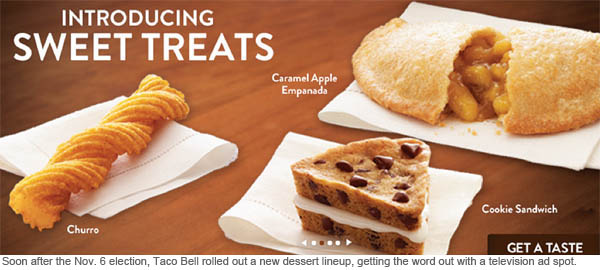
Culver’s was not alone in waiting for the Nov. 6 election to pass before returning to TV. In the days following the election, Carl’s Jr. ran a new commercial for its breakfast biscuits, and Taco Bell rolled out a new dessert lineup and an upgraded steak nachos dish. Pizza Patrón kicked off a new promotional campaign with soccer star Lionel Messi, as well.
Jeff Fromm, executive vice president for Kansas City, Mo.- based ad agency Barkley, speculated that those brands did not want their messaging to compete with the constant negativeads generated by the elections.
“Nobody wants to advertise in the days before the election when they’re competing with one obnoxious ad after another,” Fromm said. “Honestly, there’s such a drain on ad inventory that it’s not surprising [restaurants pulled back from broadcast ads].”
This year’s campaign achieved record levels of spending for political TV ads from candidates and outside groups. The Center for Responsive Politics estimated the week before Election Day the 2012 races for the White House, Congress, and state and local offices would generate more than $6 billion in ad spending.
According to Kantar Media’s Campaign Media Analysis Group, preliminary estimates for the presidential race alone showed that President Barack Obama’s and former Massachusetts Gov. Mitt Romney’s campaigns, along with their parties’ national committees, super PACs and other outside groups, spent more than $950 million on TV ads alone.
Kantar also noted that the Obama campaign not only spent hundreds of millions of dollars on TV and radio commercials, but it also began buying up ad inventory early in the general-election cycle. As early as April, the campaign began running ads that focused on Romney’s time with Bain Capital or his opposition to the auto industry bailout before the challenger’s campaign could define his image. Romney’s campaign significantly increased its TV buying in late August after both parties held their national conventions.
Shifting spending
Timing was an important variable for restaurants during this election cycle, as well, as many brands planned advertising
pushes or new-product launches for times when they would not compete with electoral campaigns.
The election partly caused traffic at the nearly 850 Buffalo Wild Wings restaurants in the United States to fall about 2 percent in October, officials for the Minneapolis-based brand said during its third-quarter earnings call. The chain’s inability to keep pace with October 2011’s TV advertising lessened the traffic benefit Buffalo Wild Wings had experienced due to more Thursday-night NFL games drawing in customers.
“This is an election year, so we were proactive,” chief financial officer Mary Twinem said. “We have media — obviously you see it in football [broadcasts]
in October — but … we backweighted [marketing spending] because of the election for November and December.”
Steve Wiborg, president of Burger King North America, said during the Miami-based brand’s third-quarter earnings call that its 2012 marketing calendar was “budgeted and decided more than a year ago” in order to launch the chain’s new menu before ad space got too scarce and expensive during the election and the Summer Olympics.
Burger King’s overhauled menu debuted in April with a series of celebrity-driven commercials, while a limited-time barbecue menu ran during the summer. Both helped drive a 1.6-percent same-store-sales increase and positive traffic in the United States and Canada for the Sept. 30-ended third quarter, Wiborg said.
“This was all in our plan in the beginning and why you saw us choose the second quarter [for] our launch of a lot of these platforms with the media deals we received then,” he said. “We’re right on target for our plan, and we’ll close out the fourth quarter exactly on our target and plan for our marketing spend.”
Electing to experiment
The Cheesecake Factory also shifted its marketing spending this year, but from the first half of the year to its Oct. 2-ended third
quarter, which would have coincided with both parties’ national conventions, when the campaigns’ media onslaught began in earnest. Chief financial officer Doug Benn said overall marketing spending would remain the same 0.5 percent of sales for fiscal 2012, but the third-quarter shift allowed Calabasas Hills, Calif.-based Cheesecake Factory to test a branding campaign with billboards and radio.
The chain’s third-quarter same-store sales rose 2.5 percent, which included a 1.5-percent gain in traffic. Its 173 restaurants
are spread out nationwide, with concentrations in many markets without competitive presidential or congressional races, like California and Texas. The brand does not advertise on TV, so Cheesecake Factory did not experience the swing-state blues many chains endured this election cycle.
However, Benn noted during the third-quarter earnings call that the presidential debates and election night, when people are either voting or watching the returns on TV, likely would pressurefourth-quarter traffic slightly.
Similarly, Culver’s spent the same amount on marketing during the election cycle as it did last year, Stidham said, but the chain used its exile from the airwaves to bolster local-store marketing with increased print ads, social media and freestanding inserts and to experiment with new tactics.
“We bought digital network TV in our tier-one markets, really just testing to see a lift,” Stidham said. “We learned quick it did not draw enough just on its own, and we don’t envision digital being a stand-alone platform for us, but it could be important as a supplemental [tactic].”
The chain went back on the air Nov. 12 to reprise its “Welcome to Delicious” TV campaign, leading with a commercial starring founder and chief executive Craig Culver talking to the brand’s beef supplier. Stidham added that Culver’s same-store sales were positive in September and October and are trending positive in November, as well, despite going dark for several weeks.
“We’re still having a great year,” he said. “We think we widened our base with ‘Welcome to Delicious,’ and that’s why we continue to grow.”
An important lesson restaurant marketers can take away from the campaign is that having a lasting, relevant brand message that keeps people talking about a chain — increasingly through social media — can help offset an absence from TV or radio, said Barkley’s Fromm.
He said other restaurants can prosper, as Culver’s did, during a broadcast blackout if they focus on “content excellence” rather than just creative excellence
Contact Mark Brandau at [email protected].
Follow him on Twitter: @Mark_from_NRN