
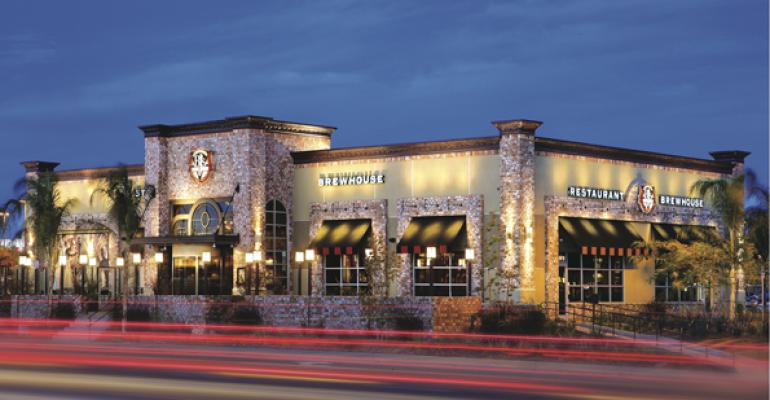
BJ’s Restaurants Inc. reported a 29-percent decrease in profit for the fourth quarter Tuesday, saying sales trends are softening as consumers pull back on dining out in light of payroll tax increases and other pressures.
The company reported that the decline in net income was largely due to one-time pre-tax charges during the quarter that ended Jan. 1 and an additional operating week the prior year. However, in an earnings call with analysts following the report, Greg Levin, BJ’s chief financial officer, said the chain saw “a lot of choppiness” in the fourth quarter and noted that same-store sales were negative going into the new fiscal year.
For the first seven weeks of the first quarter in January and February, same-store sales fell 0.5 percent, compared with an increase of 4 percent for the same period last year, he said.
RELATED
• BJ's warns on volatile consumer spending
• BJ's posts lower-than-expected 3Q revenue
• More restaurant industry finance news
Consumers appear to “need a catalyst or an event to dine out,” said Levin, and they are also generally pulling back on dining out midweek. “In fact, the first quarter feels a lot like 2008, in which the middle of the week has become soft with weekends and special events holding up relatively well,” he said.
Levin predicted it would take about two quarters for consumers to adjust to the “new reality” of “a little less jingling in their pockets” as a result of higher payroll taxes and other changes in tax regulation this year.
The fourth-quarter report was the “final watch” for retiring chief executive Jerry Deitchle and the first earnings report for his replacement Greg Trojan, who stepped into the CEO chair earlier this month.
Raising brand awareness
The company is targeting several areas for improvement, including raising awareness of the brand in all markets, according to Trojan.
“We need to refine our brand positioning and look to spend efficient marketing dollars to drive even more traffic into our restaurants,” he said, noting that one of BJ’s strengths is the diversity of guests and the reasons they visit.
“How do we communicate what we do and what BJ’s is to such a varied constituency when it represents quite different experiences to so many?” he continued. “A difficult mission, but essential to fully realizing our potential in my mind.”
Trojan said the chain will also work on its plan for future development, rethinking the traditional 8,500-square-foot footprint for BJ’s restaurants.
“I’m convinced that we need more flexibility in the box that we are building,” he said. “We need to be able to fit in smaller places in older established real estate constrained markets, like the Northeast, for example. A smaller footprint will also make us more competitive in smaller markets, which dictate a lower upfront investment.”
In addition, Trojan plans to work on the chain’s human resources strategies with the goal of becoming “the company of choice to work for at all levels of our team,” he said. “Given the challenges laid out by health care reform and other regulations, we will look for opportunities to manage these changes in a way which widens our competitive advantages.”
Meanwhile, BJ’s is increasing its marketing spending and promotions during the first quarter. The chain is expanding a test of TV advertising in six small markets, covering about 28 restaurants.
In addition, Levin said BJ’s will be “very prudent” on menu pricing this year, focusing on “everyday affordability.” Menu prices will likely increase 2 percent for the year, including a 3-percent increase during the first quarter and 2-percent increases for the second and third quarters.
The company expects commodity costs to increase about 2.5 percent to 3 percent for 2013.
A look at the numbers
Continued from page 1
Net income for the quarter was $7 million, or 24 cents per share, compared with $9.9 million, or 34 cents per share, a year ago, which included an extra operating week that contributed about 6 cents per share.
During the fourth quarter that ended Jan. 1, the company also saw pre-tax charges totaling about $1.4 million, or about 4 cents per share, related to the cost of a California sales tax audit and one-time costs associated with the chief executive transition.
The same-store sales increase of 3 percent reflected the benefit of menu price increases and a favorable mix that offset a 0.9-percent decrease in traffic.
“In our view, maintaining 99 percent of our guest traffic in our comparable restaurant sales base was really a solid achievement for the fourth quarter in light of all the headwinds we faced,” said Levin, crediting the chain’s steak-and-seafood entrée platform and the two-dine-for-$14.95 lunch special promotion.
Revenue for the quarter increased 8 percent to $184.8 million, compared with $171.8 million a year ago, including an extra operating week in fiscal 2011 that contributed about $13.9 million in sales. Excluding the extra week, revenue would have risen 17 percent for the quarter.
For the entire year, BJ’s said revenue increased 14 percent to $708.3 million, compared with $620.9 million in fiscal 2011. Same-store sales increased 3.2 percent for the year.
Net income for the year was $31.4 million, or $1.09 per share, including pre-tax charges of about $2 million, compared with $31.6 million, or $1.08 per share, the year prior.
BJ’s said 16 restaurants opened in fiscal 2012, including five during the fourth quarter. Another 17 openings are scheduled for fiscal 2013, including the relocation of a smaller format restaurant in Oregon to a larger “Brewhouse” unit.
Based in Huntington Beach, Calif., BJ’s ended the year with 130 casual-dining restaurants under the BJ’s Restaurant & Brewery, BJ’s Restaurant & Brewhouse, BJ’s Pizza & Grill, and BJ’s Grill brand names.
This article has been revised to reflect the following correction:
Correction: Feb. 20, 2012 An earlier version of this story had incorrect references to the fiscal year that ended Jan. 1, 2013.
Contact Lisa Jennings at [email protected].
Follow her on Twitter: @livetodineout


