
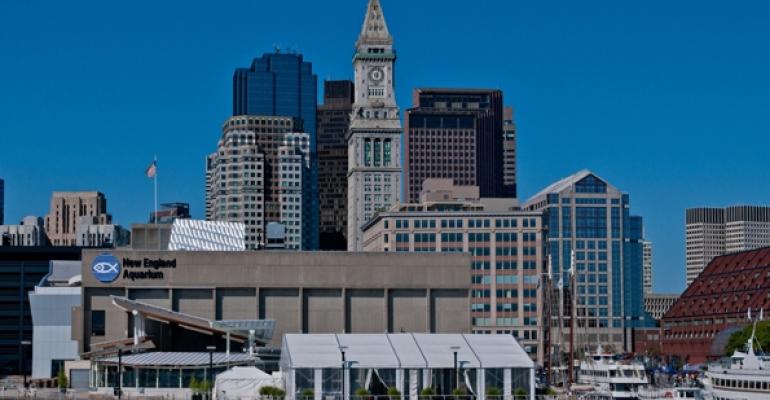
The New England Aquarium in Boston has teamed up with seven Massachusetts restaurants to highlight seafood that is being raised or fished in an ocean-friendly manner.
Dishes made using the seafood species selected by the aquarium will be highlighted as “Blue Plate Specials” at Blue Ginger in Wellesley, EVOO in Cambridge, Turner Fisheries Restaurant in Boston, Lumière in Newton, Area Four in Cambridge, Taranta Restaurant in Boston and City Landing in Boston.
RELATED
• Origin labeling key to restaurant seafood sales
• Roe elevates everyday restaurant menus
• More restaurant industry seafood trends
“I think it’s a huge responsibility as a chef to take care of our sea,” said Ming Tsai, chef-owner of Blue Ginger and the newly opened Blue Dragon in Boston, as well as a member of the aquarium’s advisory board. “Want it or not, we have a lot of influence on what people eat. The sea is not infinite. When you watch National Geographic and you see that this species or that species is almost extinct, I worry about whether my children are going to see it.”
Tsai also noted that as a chef, he’s on the front lines of observing fisheries that are in trouble. For example, years ago at Blue Ginger he made a dish of miso- and sake-marinated Chilean sea bass. Back then it was easy to get fillets that were three feet long and two feet thick. Then he started getting fillets under two feet before news came out that Chilean sea bass were being overfished.
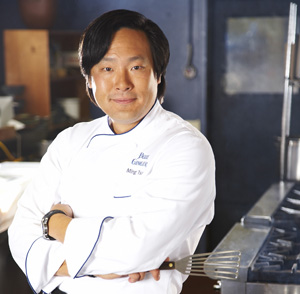
It took him nearly a year to find an adequate substitute, but after consulting with his purveyors, he settled on line-caught butterfish, also known as black cod or sablefish.
“It’s also the best tasting fish in the world,” Tsai said.
He’s featuring that dish — which has long been Blue Ginger’s top selling entrée, as his Blue Plate Special.
Tsai said highlighting the dish as sustainable is an opportunity to educate customers about the finite nature of the oceans’ resources. “People want to help this cause if it doesn’t take time and money, and it’s very easy to do,” he said, adding that he guides interested customers to the Seafood Watch smart phone app, which lets customers research a seafood item before ordering it in a restaurant.
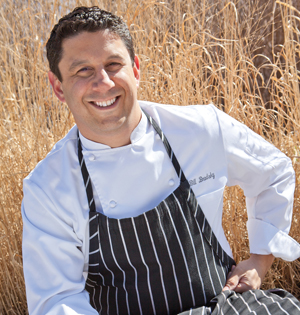
Bill Brodsky, chef and owner of City Landing restaurant, which is across the street from the New England Aquarium, said he became involved in the project because he admires his neighbor’s sustainability initiative. “While the aquarium is a nice place to spend a day, I don’t think people realize how much research is put forth by the organization.”
He’s featuring two items as Blue Plate specials: Alaska pollock fish and chips, and long-fin squid calamari. “The long fin’s actually a product that we use all the time,” he said, noting that the squid species is great from a sustainability initiative because they reproduce quickly and swim in large schools, making it easy for fisherman to catch them with very little bycatch — other species that unwittingly get caught in the fishing process.
The pollock is a replacement for local haddock, which is what’s usually in his fish and chips. “Pollock’s a very cool species of fish,” he said. “It reproduces amazingly fast so they’re in no danger of going extinct, and [Alaska fishermen] have very advanced methods of fishing these pollock so they don’t disturb the environment.”
Raising consumer awareness
Heather Tausig, associate vice president of conservation for the New England Aquarium’s Sustainable Seafood Program, said she is experimenting with different ways to communicate with the public and get them to make “ocean-friendly” choices.
The six-week project started on February 22 and is running for six weeks, so that the awareness-raising campaign runs during the Boston Seafood Show — the largest international seafood show — as well as during Lent, when many Catholics abstain from eating meat on Fridays.
“Most of these restaurants that are running the Blue Plate Special are run by chefs we’ve worked with in the past who are working to highlight and differentiate themselves as well,” she said. “As we engage more chefs, we hope this is something we can do more often,” she added.
The Aquarium’s role is to provide the chefs, and their servers, with information about the highlighted species that they can share with their guest, as well as to engage in cross-promotional activities in traditional and social media. “It’s really a cooperative marketing opportunity,” Tausig noted.
Raising awareness of seafood sustainability is particularly important in New England, where many people make their living off of the ocean’s bounty. “New England is really a hotbed for fishery issues,” Tausig said. “And any negative messages that come from the media [in the United States] traditionally focus on some of the challenges we face in New England.”
However, choosing sustainably raised or caught seafood helps support healthy oceans by supporting best practices in both fishing and aquaculture.
The species selected by the New England Aquarium for the Blue Plate Special project are Alaska pollock, Alaska salmon, Atlantic deep sea red crab, Atlantic mackerel, U.S.-farmed bay scallops, U.S.-farmed catfish, farmed clams, Dungeness crab, U.S.-farmed kelp, long-fin squid, market squid, farmed mussels, farmed oysters, Pacific sardines, redfish, sablefish, U.S.-farmed or wild striped bass and wreckfish.
Tausig said the species being highlighted range from domestic to international and include wild and farmed species, “because we see great choices in all of those. I think that’s an important message we’re trying to communicate.”
So is highlighting success stories, she noted, such as the rebounding of species such as striped bass.
“It’s a lot of work, but it’s exciting to be doing things that are important to the health of the oceans and the human communities that are dependent on them.”
Contact Bret Thorn: [email protected]
Follow him on Twitter: @foodwriterdiary


